Thursday, March 17, 2011

A Different Life


I find myself in a two room flat on the third floor of a refurbished duplex. The floors are a warm honey color speckled with tiny dark knots. The only remaining architectural hint of the apartment’s long past is the embellished molding of flowers and leaves nestled in the corner between the walls and ceiling which outline the apartment’s perimeter.
Besides the whisper of a long forgotten period of detailed craftsmanship, the flat is decidedly modern. The kitchen, though small and lacking more than a few plain cabinets, is complete with chrome refrigerator and marble counter tops. Colorful snapshots and notes on brightly colored post-its dot the fridge’s double doors.
In the same room as the kitchen, though closer to the large street-facing window, is the square dining room table. The formal table is a bit too large for the space, surrounded by matching dark wooden chairs along all four sides. There is a two foot perimeter between the chairs and two walls perpendicular to each other, as though the table was bought for another space and then crammed into this one, like a woman squeezing into a dress one size too small. The table, designed with a minimalist aesthetic, is covered with scratches and the rings of coffee mugs which have removed parts of the dark, espresso colored veneer.
From where I am sitting in the living room, on the plush cushions of the L-shaped couch, I can see a narrow credenza in one corner of the dining space covered with framed photos of babies and a wedding ceremony at city hall. A clear glass vase, two feet tall, holds a bouquet of calla lilies. The sweet, sticky scent of their ripe pollen permeates the small apartment.
The living room is crowded too. The plush gray colored suede sofa takes most of the floor space, though it is the blanket of baby toys on the ground surrounding the couch which seem to close the space in, making it difficult to walk. The couch faces the dormant fireplace and narrow mantle, which is covered in a dozen stacks of CDs. They line the mantle in stacks of five or six, perching like flat pigeons on the thin brick ledge. Just over the mantle is a flat screen TV mounted directly to the wall. Just like the couch and dining room table, dominating objects in their respective locations, the enormous glowing TV takes up nearly the entire wall. I turn to it, finding it hard ignore the basketball game blaring forth from the flat surface. Beside me, an enthusiastic young man is shouting at the TV, looking like a teenager in his red and white striped shirt and baggy jeans. He had been trying to ask polite questions, making simple conversation while he and his wife waited for the taxi to arrive, though as he tried, he just was not able to take his eyes from the TV for more than a few seconds at a time.
An eleven month old baby with big brown Bambi eyes is sucking on a green pacifier beside his sport-obsessed father. “So what were you saying?” the man turns to me with divided attention.
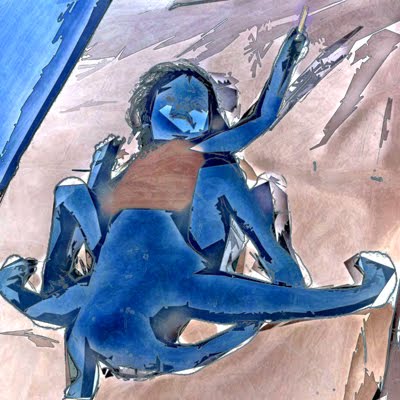
“I was just saying that I take these photos and then turn them into something else, I can show you.”
“Yeah, show me,” he says enthusiastically.
I begin turning on my computer, looking through the multitude of dated folders, trying to avoid any risqué photos that might jeopardize their faith in leaving me along with their child for the night.
“What’s that one?” he says, pointing to a colorful thumbnail. I enlarge it, a highly altered photo of a man wearing a feathered mask.
“Is that a bird?” he asks.
“It’s a guy wearing a mask with feathers.”
“Oh. I like it. Show me more!” He turns back to the game. “Oh come on!” he shouts at the TV.
His wife approaches. A heavy set woman in high heel boots. She stands next to her husband, touching his arm. The gesture strikes me as forced, as though she needs to protect her territory from me. Looking around the space, I realize that it is she who has picked the couch, the table, the adult pieces of modern furniture. She seems old to me, not so much in her appearance, but in her approach, in her way of being.
“Okay, hun, the taxi is here,” she says as she glances out the window.
When they are gone, leaving the baby in his crib just moments before walking out the door, I wander around the apartment, looking more closely at their photos, at the accumulated items of their lives. They are a young couple, two people very identified with their Jewish heritage. There are references to it all over the apartment. From the brit milah pictures of the baby to the name of their network wireless connection, it is there, saturating their lives, a huge part of their created culture.
It is then I realize, these are the people I might have become. These are the people my parents had hoped I would be, the life they wished me to have. A stylish apartment with adult furnishings. The marriage, the baby, the teaching job. They are an off-shoot on the path. I begin to take pictures, using their world for another purpose, exploring the choice I didn't make.

Sunday, March 13, 2011

Peril At Sea


White shirts and water and old men and old jokes and leather shoes and a long white wall and I found myself on a boat, a ship rather, a huge traveling machine that embraced me in metal arms. It was noisy and busy in there. The noise startled me out of the strange thoughts that had just been running through me. Dislocated fragments of words and images, visions of correspondences and breaking points, twisted thoughts, mangled thoughts, thoughts I immediately forgot.
I looked around myself and I quickly found my place within the crowd, I quickly found my allocated purpose, my duty, my role in the scheme of things.
I was on a large transatlantic ship, an elegant old ship heavy with history and tall tales lost in the deep blue waves of the high seas. There was a feast happening in the main salon, a sumptuous chamber which invoked a kind of luxury that I had rarely experienced directly. The floor was cushioned by thick red carpets that made you feel as if you were walking on clouds each time you took a step. The elegant round tables were all covered with white or pink table cloths. There was an enormous chandelier hanging over the center of the dancing floor, twinkling with golden light.
I was tired in the middle of all of the frantic movement, tired and slow and hesitant. So many people surrounding me and yet I felt all alone, totally separated from the celebration that was happening all around me. My hands trembled slightly but I wasn't really cold, my eyes watered but I wasn't really sad. I wouldn't want to say what I felt because I didn't have a word for it, I still don't. I didn't know why this was happening, that was clear. But then again, I didn't know why anything was happening at all, why anything had ever happened.
There were people everywhere, all of them enjoying themselves in a way that spoke of certainty and financial security and a kind of carelessness that came with it. Laughter came from all directions, waves of laughter that washed over me with such strength that they nearly pushed me over. They seemed to insist that I should set aside my thoughts, these waves of merry washed in champagne.
It was definitely hard to think clearly with so much noise, so many bits and pieces of unknown conversations, so many scattered statements, so many loose words. My mind would try to grab onto one phrase but it had soon been displaced by another, and my own chains of thought would be broken by the collective mental discharge.
I was removing the dirty white dishes that constantly piled upon the table tops. I saw several of them in my hands and noticed there were more to be picked up. I was wearing a black and white uniform that clearly distinguished me from the guests. The uniform was simple and standard: a white dress shirt, a black vest and a bow tie. To clear the tables was my job aboard this ship. At least one of the jobs I was meant to fulfill.
I looked around to catch a glimpse of my fellow workers. I could see other men and women wearing the same uniform I had on, each with a job to do, each with their hands full of dirty plates and utensils or walking back from the kitchen with freshly washed plates full of hot food.
While we worked, the crowd feasted, it moved as one large being of many heads and many arms. I spotted Vicky among the workers walking out of the kitchen. She was a quick glimpse of recognition among so many faceless strangers. Of course she was here. Where else would she be? I tried to catch her attention but there was too much happening and it was all moving too quickly. I soon lost her in the haze of movement.
I continued to clear away the unwanted remains. I felt so separate from these people, from the feasters, from the workers, from everyone. I felt clearly marked as someone to be ignored until needed, a part of the rumbling machine, a kind of moving breathing furniture.
"They are the Other. All that is not me. All that I can see and everything I cannot." The thought went through me as I looked at the guests laughing, eating, drinking. I could feel the floor weaving slightly under my feet, more than I was used to, more than seemed reasonable or comfortable. "There's no use in asking for a reason. They are that which you cannot control. They are that which moves beyond your grasp."
There was soft music coming from large speakers at one end of the room, a kind of soft jazz without claws that could be easily ignored and set aside as sonic wallpaper.
There was the tinkle of clinked stemware and the scrip scrape of knives scratching plates. Little ribbons and pearl centerpieces adorned the tables in a fixed simulation of living flowers. Round men in tuxedos bared toothy grins as I passed them by. Maybe they intended to flirt with me, maybe the alcohol had robbed them of their skills of distinction and they now thought I was their friend, their wife, their mother.
Women in satin and taffeta wore tight hair buns and white gloves. They never looked at me unless they had a particular request. Some of them danced with a cultivated air of nonchalance, some of them lightly swayed as they talked to each other. Their shoulders were bare and tanned, their faces were painted. Artificial flowers, like the ribbons and the pearls.
I scrambled to keep up with the pile up of dirty dinner ware. At least that was something clear for me to do, a task I could understand. I carried a toppling stack back into the kitchen area, wrestling with my own turbulent feelings which threatened to take me over, thoughts that slid down the side of my cranium like avalanches of words and letters spilling away from their original container. I avoided the steady stream of workers which all came in and out through the same door. I looked for Vicky among them but she wasn't there.

* * *

As I crossed the kitchen doorway, I was greeted by a rush of warm moist air. It could have been a relief from the aimless confusion of the party, a direct rush of heat that was clear and distinct in its manifestation. It would have been a relief but it wasn't. It felt heavy and uncomfortable. As soon as I walked in, I wanted to get out, I wanted to escape the sense of suffocation, the oppressive weight of the hot air.
The cook was a middle aged man wearing a huge white chefs hat, white pants, shirt, and apron. He had a clean looking thick mustache and large black eyes. He was leaning against a counter, sweating profusely and talking to a smaller man with brown skin and narrow shoulders. The smaller man mostly nodded to whatever the cook had to say, with an obvious subservience that made my skin crawl. I was not sure if he even spoke the same language as the rest of us. It didn't matter to the cook. He just kept on talking in his loud boisterous voice.
I felt very small next to him. Without realizing I was doing it, I stopped to look at the two of them talking, to listen to what it was that he had to say in such a loud strong voice that made the kitchenware vibrate in resonance.
He glowered down on me when I looked up at him, he stared directly at me while complaining boisterously about the incompetent level of help on these journeys. I immediately blushed intensely and moved away. He was obviously talking about me. He had to be. He had looked right at me as he talked. I felt afraid of him, afraid of his opinion, of his judgement. I was afraid and yet I would have given anything to have him like me. Obviously he didn't and there was nothing I could do to change that.
I heard louder laughter coming from the main room, even louder than before. I suddenly knew that in the dining room the situation would soon be getting out of hand. Intoxication would breed further intoxication and shameless acts of debauchery. This was the kind of party that could go on all night, growing wilder and wilder as time went on. A mad celebration of wealthy decadence. More than expected and yet somehow understood. I knew these things happened. I didn't look forward to them but they were somehow unavoidable. They could be surmounted, they could be dealt with. This knowledge lived within me in a place I couldn't pinpoint.
I walked away from the cook who was still talking loudly, his voice travelling like a strong committed melody over the grueling rhythm of the crowd. I felt his eyes on my back like heavy cables of steel that reached invisibly from his mind into my muscles. I didn't like it. I wanted to get away. I wanted all of it to disappear.

* * *

Without meaning to do it, I found a metal door that led me to the outside. It was an oval shaped door on the side of the kitchen, the kind of door you only find on a ship. I found it behind the shelves where all the supplies were kept. I had never seen it before. I had been in this kitchen many times and yet I had never noticed a door right there. It seemed unlikely that I would have never seen it, that I would have missed it each and every single time I had been in here. And yet there it was, waiting for me to open it.
I made a sudden decision to walk through it, without having a clear thought of what waited on the other side, without a clear anticipation of what I would encounter. I had no real expectations, no urge for discovery. I simply wanted to get away, I wanted to go elsewhere and that was exactly what the door promised. Elsewhere.
I stepped through it and I let it close behind me with a loud clang that resonated in my ears like a gong. I found myself outside, on the edge of the ship, under the dark cloudy night sky, looking at thick ominous waves that battered the ship like amorphous giant demolition rods. There was a hard rain coming down and a strong wind that made me shiver as soon as I stepped out. It felt somewhat good for the cold raindrops to hit my face harshly, tiny water projectiles propelled by the raw force of the wind that seemed to make the entire world shake around me. I shivered and the whole ship shivered with me. It reminded me of something but I couldn't quite place what it was. It wasn't something exactly pleasant, and yet I welcomed it. It was the change I had been hoping for.
There were two men outside with me, standing by the railing, their silhouettes framed by the night and the waves. One was about my age and the other one was much older. As soon as I heard them talking it became clear that they were father and son. It was also clear that they had some kind of official capacity aboard the ship, some kind of authority that lived in the structure of their spoken sentences. It was as if they carried their certifications on their voice and their demeanor. There was no need for badges when you could carry yourself this way.
Like the door I had just walked through, I had never seen them before. It was a large ship, full of strangers, but it still struck me as odd that I would never have run into them. And yet they seemed to be where they were supposed to be, they were in charge of a situation, a situation that involved me.
The older man was dressed in an elegant dark suit. There were golden cufflinks on his sleeves and his shoes were polished to perfection. He had undone his tie and unbuttoned the white shirt underneath it. In the twilight darkness of the outside, I could see a bit of his hairy chest, long white strands of hair that betrayed both his age and his old fashioned masculinity. I found it oddly attractive. I wanted to lay my head on his chest and go to sleep.
The younger man wore a thick white sweater. His pants were a light beige color and they were splotched with water. He seemed just slightly less sure of himself than his father was. But there was a hint of the same elegance in his movements, there was a touch of the same hard earned stability in his stance. His longer hair was a shambles from the wind and the water. The older man's hair didn't seem to move at all. It was as if the whole world couldn't touch him, as if he stood invulnerable no matter what came at him, no matter what violence transpired in the immediate vicinity of his personal space.
They turned towards me as soon as they saw me. Almost as if they had been expecting me, or at least expecting someone from the inside to show some level of interest in what was going on outside.
"We will have to sink the ship. There's no way around it." The old main said it with an air of finality that seemed beyond question. I nodded slowly, unsure if I was understanding correctly, unsure if I was even meant to hear this. Maybe they were confusing me with someone else?
His voice startled me when it erupted above the thunder of the waves. I sensed that I would be ready to believe anything that vibrated in those resonant timbres.
"Don't worry," the younger man said, looking at me with an air of tender nobility, "it's common practice. It's the only thing we can do in this situation. We have done it before. Many times. Everything gets wet but we survive. It's the only way. It's certainly not pleasant but it's the only thing we can do."
"When the boat goes down," the old man said, again with a thick deep voice that seemed the very incarnation of authority, "you will feel a pull on you...a very strong pull. The ocean will rise up around you and pull you down. You will have to swim very hard towards the surface, harder than you have ever swam before. You have to make sure you don't get pulled down. Do you understand? At that point it's important to resist the force that will be pulling on you. Just swim towards the surface as hard as you can, don't follow any impulse to give up. You will be tired, a voice in your head might say that it would be good to surrender to the force all around you. It will seem like a pleasant option. Don't listen to that voice. Set it aside and continue to struggle. Don't surrender. Don't give up. At this particular point, giving up is not a good idea."
Again I nodded slowly. I wasn't sure if I could even swim that hard. I looked towards the tall waves that slammed against the sides of the ship. In the middle of those waves, I wasn't sure that I could swim at all. I wanted to ask questions but they all accumulated at the tip of my tongue and refused to make the final jump out of my mouth. Instead I just looked at the two men and they looked back at me. Our conversation was over. I turned around to go back inside.

* * *

I ran back to the small cabin I shared with Vicky. I felt dizzy with apprehension and a sort of aimless confusion that didn't give me a firm footing on which to stand. As soon as I had changed out of my wet clothes, I started to put my papers and jewelry into plastic bags so they would not get lost or ruined. I sealed each one carefully, moving as fast as I could manage. I tried to not get bogged down looking at these things, but every once in a while I would stop to focus on one, a ring, a necklace, a tiny photograph, a little clay figurine. I would remember where I got each one, who gave it to me, who sold it to me, who was there when I got it. I would remember the incident that surrounded each item like a cloud of blurry images circling around an empty sun, a tiny thing that couldn't be grasped, a vortex of longing that didn't have a clear conclusion, a distinct end. Most of these things were basically worthless from anyone else's perspective, and yet they still held some kind of value for me, some kind of weight. I wondered if this would be the last time I would ever see them, the last time I would ever see anything at all.
I put all these little bits of property inside a small blue backpack which I placed next to my bed. My mother had given it to me when I was preparing for this trip. At the time I couldn't think of why I would need it. Just as I finished arranging the backpack and all the things inside of it, Vicky walked in. She was still wearing the uniform we had all worn for the party. Her long blond hair was a mess and there were raindrops on her face and jacket. She had been outside like me, maybe she had walked through the same oval door I found on the wall of the kitchen. I didn't ask her about it.
She closed the door behind her and started to undress. As she changed, she talked to me without turning in my direction. She talked in an exaggerated whisper. I looked at her naked back as I listened and I felt a mixture of worry and excitement coming from her voice.
"They are digging a grave for the boat on land. The captain radioed ahead to let them know what is happening. This is probably the last time we'll be together in here. Anything you want to save, you better hold on to it."
I pointed to the backpack and she nodded. I wanted to say more but it all seemed pointless. She was putting on a tight rubber outfit, the kind used by divers and surfers. I didn't know she had this kind of equipment. I had no idea where she got it from. There was obviously a lot of things I didn't know. Was my whole life a long line of avoided questions? A pattern of avoiding obvious clues even when they sat right in front of my face?
Up to this point, I hadn't uttered a single word while Vicky explained the procedures we would follow. She was being very detailed and methodical in her explanations. I listened as carefully as I could but suddenly I couldn't hold it any longer.
"I was not aware that there was even a remote possibility that I could die on this trip..."
She turned around and looked at me with wide eyes. She stopped in the middle of getting dressed, and just looked directly at me. I looked up at the few rain drops still shining on her cheeks. The yellow light of the cabin made them shine and shiver, like tiny stars on her face.
"There is always a remote possibility, at least a remote possibility. There's no such thing as total safety. Nowhere. Never. You should know that already. You should definitely know that from now on."
Again I nodded. These things seemed so self evident, things a child should know, things I should have been taught when I was growing up. But who would have taught me? I had never thought about the underlying possibilities before. If I had, I didn't remember. I had certainly never confronted them face on, I had never looked into the bottomless abyss that lurked under all my seemingly innocent choices.
"Did you give your parents a way to call you?"
I shook my head.
"Maybe you should call them. Just in case..."
I looked at her and then at my cell phone resting on my night table. I hesitated. Maybe it was better to not call. Maybe it was better to not know what was happening, maybe it was better to remain innocent just a little longer. Maybe it was better to find out until the crisis had passed and a resolution had emerged, whether good or bad. I couldn't imagine listening to my mother's voice while those huge waves kept crashing against the side of the ship, reminding me of the imminent presence of radical change. To hear her voice against that background would break me somehow. It would make me weaker and I needed to be strong.
She shrugged her shoulders as if she could read my thoughts.
"There's another suit in the closet behind you. You should put it on. We might have to swim for hours if we are still out on international waters. There's always a chance we might get picked up fast, but we shouldn't count on it."
I went to the closet and opened the door. I took out the suit that I found there. I had never seen it before. Again, it seemed strange that I had never noticed it. I ran my hand over its contours as if to convince myself that it was real. Were they distributed while I was working at the party? Had it been there all along and I had simply ignored its presence?
I had already changed into jeans and a T-shirt as soon as I came back to my room but now I undressed once again to change into the rubber suit. I felt somewhat embarrassed to have Vicky standing there, looking at me naked. We had both seen each other naked countless times, and yet this particular night I felt more naked than ever before. I felt as if she could look through my skin straight into my insides, straight into the inner forms that I would forever want to hide.
I could hear the waves outside getting louder, the waves beyond the walls of the cabin, beyond the edge of the ship. Outside was the Other. Everything past this wall of pale skin and this head of short dark curls was the Other. Everything. I was scared to be outside, I was scared to lose my limits, I was scared to lose my self. I was scared of it all. I felt small and weak and completely vulnerable, naked in front of the world which looked at me through Vicky's eyes.
All the stories I had ever heard, all the years of memories that I would never have access to, they were all trying to flood into my shaking mind. I didn't want to go outside to meet the Other. I didn't want the Other to come into me, to turn me inside out like an old sock and change me forever, damage what I had come to know as my world, twist it beyond recognition. I wanted to close my mouth tight so the Other wouldn't find an open doorway in the middle of my face, I wanted to close all the gates and tell it to go away, to come back when I was ready. And yet I wasn't sure that I would ever be truly ready. Not for this. Not like this. Not for something so utterly final.

* * *

I was standing next to Vicky, overlooking the open grave that would be the final resting place for the ship we had lost at sea. People had gathered around the dark moist hole, waiting for the broken bits to be moved in, broken remains of what had been a proud seagoing vessel not too long ago, a place to dream, a place to wonder, a place on which to stand and look out at the vast blue emptiness.
"It was a hard choice, to sink the ship, but it had to be done. There was no other way around it... you know? It could have been some other ship, it just happened to be ours. That's the way things are."
Vicky said it offhandedly, as if she knew I needed her to talk and she just grasped at the first thing that came into her mind, regardless of whether she really believed it or not. I felt vaguely grateful for her words, even if I couldn't understand them, even if I couldn't walk straight into them and make them my home.
I looked at her and she looked at me. Her blonde hair was still wet. My own curly black hair was wet as well. I could feel cold drops of sea water running down my neck, slipping over my shoulders to slide down my back.
Her blue eyes were even clearer than I remembered, as if they held the essence of hope within them, a kind of gentle hope that drifted easily over calm waves of doubt. We were both shivering even though the sun was already shining high in the sky, already slowly burning our skin, already slowly evaporating the remains of our cold midnight swim.
We looked at each other intensely for a moment, two sets of eyes wide open and staring, each looking into the Other, each exploring the wide open mystery that was hiding behind the Other's eyes.
What is it even possible for me to stare into the reality of her and not the illusion created by my memories? The question seemed more urgent than ever. The moment in the cabin, the moment when I stood naked before her as the ocean battered our ship into submission, that one moment had opened up wounds that I didn't even know I had, it left me with burning questions I couldn't quite formulate, doubts I couldn't raise past the boundary of my eyelids.
Was there really a Vicky out there or would I soon wake up to find that she had only been a dream? If there was no Vicky, was there a "me"? Was this "me" the thing I most cherished? The ship that took me through the oceans of reality until I came to let it sink into the turbulent vortex of the void?
And when it was finally gone, what would be left behind? Would I know when it was time to sink the ship, or would it surprise me like a little open door I had never previously noticed?
Vicky smiled at me as if to tell me to give up my questions. I smiled back but the questions persisted, even as she put her arm around me, even as I smelled her sweat, even as I momentarily believed that she was real, that she would remain steady and firm and I would continue to smell her presence as the years went by. I rubbed my nose against her skin and she giggled. A tear rolled down my cheek but she didn't see it.

* * *

That night I dreamt I was in the middle of a big feast but I was not a waitress. I was walking among all the guests completely naked. They all stared at me with big invasive eyes in the middle of blank faces that said nothing. The fact that they all looked at me without any clear reaction made me even more embarrassed, more humiliated to be so completely naked in front of all of them. So many strangers, so many people I didn't know, so many people I didn't want to know.
If at least one had tried to say something, if one had approached me with interest, wanting to caress my body, wanting to kiss my lips, if some of the women had laughed, if they had made a comment, any comment at all no matter how mean or off-handed... but there was no reaction at all, not even a whisper, not even a sigh. I just walked naked among them, unable to even cover myself with my hands.
I wanted them all to go away, I wanted them all to disappear and take away their wide open eyes.
I wanted them all to stay and talk to me, I wanted them all to be my friends, to love me, to want me, to cherish me, to hold me.
Their presence and their absence, both frightening, both desirable, both recurrently impossible.
I wanted to be gone but I was afraid to leave.
I wanted to vanish but I was afraid of the emptiness.
I woke up alone and covered in sweat, the wet sheets stuck to my skin. I looked up at the ceiling and thought about the waves that I had been so afraid of, the waves that surrounded me from all sides no matter where I was standing, the waves that would eventually take everything away. I could hear them crashing against the walls, I could hear them eager to come in to release me.
I was naked in my bed surrounded by water. No shirts, no old men, no jokes and no shoes, not even a wall. Just water everywhere, getting everything wet, taking all forms away and leaving me with nothing.

Sunday, February 27, 2011

One Of Us

“’Seems ta be the problem sheriff?”
Jet and Luther sat side by side, the shade from the porch obscuring the top halves of their bodies while the sun bathed the faded denim of their coveralls. Jet posed the question but didn’t move from his spot on the bench. Beside him Luther squinted at the officer of the law and chewed a twig contemplatively.
They were both large men, but Luther was the more muscular of the two. A slight cleft lip formed a fleshy line that looked like a scar cutting upwards towards his nostrils. While Luther’s hair was a dark brown, Jet managed a dirty blonde hue and both sported penetrating blue eyes with a barely visible corona of yellow around the pupils.
Sheriff Deets scratched at the back of his scalp and glanced at his boots accumulating a new layer of sun baked dust. Then he licked his lips and smoothed his mustache with his thumb and forefinger.
“I come for Zeek boys.” He told them glancing into their faces shaded by the porch.
“Zeek? What you want with Zeek? He ain’t done nuthin’.” Once again Jet did the talking and Luther the concentrated starring.
“Couple of the Rothford’s sheep turned up mutilated, had their necks snapped.” The Sheriff answered sharply.
“I don’t see what that has to do with Zeek.” Jet replied and Luther shifted his position slowly, ominously, and with great deliberation.
“Well, folks seems to think that freak brother of yours might a’ had something to do with it.”
Luther jerked abruptly to his feet with fists clenched. Sheriff Deets flinched and Jet proclaimed prosaically:
“You might want to mind what you say about a person's brother.”
The sun beat down on the hard packed thirsty earth and the single story adobe house with its chipping white wash and tile roof cast a long shadow in the three o’clock position. An olive tree stood near the front door and a litter of cast off fruit was in the process of bleeding into the dust and a sparse smattering of dry grass. Sheriff Deets stood in the yard beside the driveway, both of which were dirty and could only be distinguished by a minute shift in elevation.
“Easy, easy.” The Sheriff spread his hands pleadingly out before him, “I didn’t mean harm by it. I just ain’t got no words for Zeek.”
Luther made no move to step down, rather his thumbs began to brush eagerly over the knuckles of his closed fists.
“Let me ask you sumthin’ sheriff. When’s the last time you or any of these ‘folks’ seen my brother Zeek?” Jet asked with arched brows.
The sheriff eyed Luther uneasily.
“Not for years. Not since…” Deets broke off and concluded, “Not for years.”
“That’s right. He ain’t been anywhere but here. So he couldn’t a’ had nuthin’ to do with the Rothfords nor their sheep. Ye’ understand? It’s a long way from here to the Rothfords. I reckon someone like Zeek would be easy to recognize along the way. But he ain’t been that way. He ain’t been anywhere but here.”
Jet stood up and stepping forward he placed a hand on Luther’s shoulder, not a hand that said, ‘easy brother’, but a hand that combined with the stance and a certain gleam in the eye said something else all together.
“So that’ll be all Sheriff. I guess you best be off, so you can find your man, cause’ he ain’t here.”
Deets looked warily from one brother to the next. Then he took a few steps backwards and nodded to them biting both lips between his teeth. He turned on a heel and headed back for his truck kicking up more dust.
The brothers watched the tan cloud settle long after the pick up disappeared down the road beyond a desperate patch of sequoia.
“He’ll come back with a deputy.” Luther said. “They ain’t never gonna forget the thing that happened.”
Jet released his brothers shoulder and took a step back rubbing his chin.
“He didn’t do nuthin’ then neither, nuthin’ that any other boy wouldn’t a done.” Jet’s voice was high and pleading. He shook his head and paced.
“Don’t matter.” Luther intoned in a thick voice. “Don’t matter what happened then and it don’t matter who done this thing. They’ll come back.”
Jet returned to his brother's side and gave his shoulder a squeeze.
“They might not.”
Luther turned his gaze on Jet.
“If they don’t this time, then they’ll come again the next time something happens, hell, they’ll make things happen just so they can. That’s the way it is.”
The two men stood in the heat looking into each other's eyes, beads of perspiration forming on their brows.
At last Jet released Luther's arm and went into the house. Luther stepped into the shade but remained standing, watching the road ahead, waiting for what might come.

Sunday, February 20, 2011

The Cloud People


They were devoted to the clouds. For generations they had dressed themselves in white and varying shades of gray, imitating the clouds with the highest form of flattery. When they passed through deserts, the women would use the dry earth to make a pale paste to cover their hair and dark skins. When they passed through forests, another chamber in the thousands through which they flowed, they would find light-seeking mushrooms and cloud colored rocks and carry them as talismans through the canopy of green.

They were devoted to the clouds, descended from them as rain drops and bursts of electric lightning, energy that had once penetrated the earth and then grown the people of sky. They celebrated the silver haired old women and the long bearded men, for there was no status higher than a body covered in the wisdom of time and clouds.

Life above was full of gifts. It was life, high above, that traveled and circled, bringing within itself water and rain and seed. The clouds brought music too. It fell from the sky, creating a percussion band on the broad leaves of the forest, on the metal of their cooking pots. It pattered on the compacted earth, a low thump that filled their ears with the music of air, water, and wind. Wherever they went, the pale gods followed. Or rather, it was they that followed the movement of the clouds. It was their life patterns that changed with the storms.

Filled and black, streaked across the sky in trails of pink and orange, dispersed across the sky in a pale gauze. They worshipped them despite their shape, for sooner or later, they would grow heavy and full and drop the seed of life upon them.

When the clan looked to the sky and could find no clouds, they sat and waited, closing their eyes and filling their mind with visions of moisture, letting their tongues create the taste of a sweet raindrop. They focused on the sky through nights of twinkling, clear lights, through days of bright sunlight. Material for their visions ran through them, passed down from generations of cloud devotees. It was not hard to see a thick gray blanket above, the drops just hanging, waiting for the right gust to carry them down. They could taste the sugar of water on their tongues, and with each electrified taste, they brought the molecules of the sky together. They waited, dreaming, pushing, creating what they loved, what they needed. For the clouds brought rain, and the rain washed them clean. Its bath could take away all their language, all their human thoughts that lingered uselessly on their skin.

They walked following the trail in the sky. Through states whose boundaries they did not know or name or recognize. Through human civilizations that were constructed from concrete and glass, entire worlds where the rain could fall and never find the earth’s womb. They walked through these places hand in hand, looking towards the sky with hopeful glances, mouths full of cool memory and storm clouds of thunder.

Tuesday, February 1, 2011

The New World


Yesterday he asks about my relationship to the café’s owners. I tell him they’re my friends. He says maybe he can make friends with me. I admit I’m easy to make friends with. His name is Erasmus.
Today I ask him if he plays chess. He says he can. I tell him I’ll bring a chessboard. He says it’s nice to have a friend. He tells me that someone else once said that we should love our friends with the greatest intensity possible from whatever distance is necessary. He explains that the woman he is quoting came to a bad end. I say that most extraordinary people do. He says that his mother was extraordinary and she led a peaceful existence. I amend my statement. Many extraordinary people come to a bad end.

This morning Walter Richard Patton came in and ordered a Danish. In high school he reversed the order of his first and middle name and came to be known by all as Dick or Dickie. His father died in Chicago the day after Pearl Harbor was bombed. The next day Dick's younger brother, Arthur, came to him and said he wanted to join the Navy. He was 16 years old. Dick helped him to alter his baptismal record by changing a 5 to a 3, thus helping Arthur to gain enough years to enlist. Dick himself joined the navy shortly after his family moved to Utah.

Erasmus told me this afternoon that he once hunted down an archeologist who studies modern artifacts; eye droppers, paper cups, anything that can be found in an urban gutter. Erasmus located him, surprisingly, tucked away in rural Maine. The gentleman told him that he had worked in Berkeley on the development of the Nuclear bomb. He described the day after the bombing of Hiroshima, standing among the scientists who had helped create the most devastating weapon designed by mortal men. He told Erasmus that they all went a little crazy that day, the day after 66,000 people were killed all at once.

When Dick came out of the Navy he found himself in California. He could never bring himself to return to his family's home. There was a reason for this. In 1945 Art was lost off the coast of a small island in the South Pacific. Dick felt responsible. He was the one who had changed that 5 to a 3.

When Erasmus was ten years old his teacher and the school's principal called a special conference with his mother. In this conference she was told that her son was mentally retarded. She asked on what grounds they were making this proclamation. She was told that he didn’t understand that he should sit in his seat. He preferred to sit in the windowsill. She was then shown a paper covered in writing and told that he didn’t understand how to write in the lines. She withdrew Erasmus from the school and sent him to another.

Dick’s grandmother came from Austria with her husband and their family. Her brother in law brought his family all at the same time, but after passing through Ellis island, the two brothers never saw or heard from each other again. They simply lost one another in the strange new world.

I listen to Erasmus conducting an interview on the radio. He is speaking with a woman from England who leaked secret documents revealing a plot to bribe members of the United Nations into supporting the Iraq war. He asks her if she regrets having done it. She tells him she does not. She explains that she had thought the war might be stopped if she revealed the truth, but nothing came of her actions. She was fired from her job, she faced imprisonment, but there was a war just the same. Erasmus thanks her for her bravery.

Dick’s father died in Chicago the day after Pearl Harbor was bombed. The day after the attack on Hiroshima, a group of scientists in Berkeley went a little crazy. One of them became an archeologist that studies modern artifacts. Arthur was lost at sea off the coast of a small island in the south pacific. Dick could never go home again. He sits in an empty café in Berkley, a very lonely old man with a heavy heart. Erasmus’s mother was an extraordinary woman who was told that her young son was mentally retarded. Later he was nominated for a Pulitzer. Now he is interviewing a person that hoped to prevent a war by telling the truth.

Someone said that we should love our friends with the greatest intensity possible from whatever distance is necessary. That someone came to a bad end. Many extraordinary people come to a lonely, painful end. They are simply lost, separated from those they once loved by choice or death or circumstance, left alone to face the strange new world.

Wednesday, January 26, 2011

Charles

The bright orange, red and yellow of crushed leaves on the gray concrete just outside the open door. Charles’s pale blue irises highlighted by red streaks crossing the whites and the puffy crimson rims of his eyelids.
A dog looks in the window at me, just the brown muzzle and the floppy ears of a canine, peering in through the lower left hand corner of the window. Men are laughing out in the street where I cannot see. Another yellow leaf drops and blows wildly in the wake of a passing car. More cars with their anxiety making noise passing close to the open door. When they pass on the other side of the street the noise is soft and pleasant like the crashing of distant waves. Even on this side of the street some cars manage to create a gentle whoosh while others gurgle, grunt, growl and roar.
The cars are small bursts of motion and color streaking past the glass like fish in an aquarium. The trucks are slow, crawling monsters of loud carbon emitting wrath. I see a bicycle leaning against the meter that serves the whole street.
A man passes by and looks in. His nose is a cruel shape, his mouth is agape slightly as if he were breathing through it, incapable of smiling with it. The eyes of a zombie, hard like marbles, uncaring. But he is young and women who like tall lean bitter young men will find him attractive. I shudder.
Charles is soft and friendly and mumbles. His flesh looks pale and soft. There is enough of it that if you squeezed him it would be like squeezing a marshmallow. Because of the way the red made the blue of his eyes look, because I was looking in his eyes and he was looking in mine for just a moment as we spoke, I contemplate what that squeezing would feel like.
That way that he talks quietly with his back turned as he moves and I’m not sure if he is speaking to me or to himself, at first it reminded me of a dream in which you can’t quiet understand what is being said. It made me feel confused and uneasy. I wanted clear bright communication.
Today it furthers his aura of softness. His mumbling fills the air around us like clouds of cotton, cushioning us within this space of hard floors and polished mahogany.
When we first met he seemed accusing, threatening, alien. He is still alien but I like being in the room with him. I wish he would not go, not now that I suspect that what disconcerted me before was only softness.
Another leaf, this one orange like brass, summersaults down behind the back of a black man in a navy blue sports jacket who is feeding the meter.
I wish Charles would not go, but he is already gone, and I am here so that he need not be. I am left wondering over the only curiously human things we said, the few words that we exchanged that weren’t about change and cream and bags and glass cleaner.
I said: “You look tired.”
The counter was between us.
He answered: “I do? Naw. I only got up at five this morning.”
At this point he is drifting away from the counter towards the door, moving backwards as if rewinding in slow motion. “I only got to sleep for like two hours the other day.”
“Geez.” I say trying to express sympathy.
“Naw.” he says, and actually what he says sounds more like ‘No Ah‘, “I figure it’s good practice, you know, for having kids.” And then he’s out the door drifting away down the strip of gray concrete with the leaves and the cars and the others.
I compile a list of data. What do I know about Charles? He is in school because he mentioned exams when he asked me to take his shift last week. He sometimes sleeps in his car. He bakes bread and manages this store. This is precious little information. His curious remark about practice for having children, does it mean he is about to be a father? Does he have a wife? A girlfriend? Is he a bachelor who actually thinks of a future in which he has children with so much hope that he takes today’s trials as preparation?
There are not enough clues for me to come to a conclusion, not enough for me to form a working picture of what Charles’s life is like.
A fire engine screams by, a big red rectangle with flashing red yellow and white headdress rushing for disaster.
I try to imagine what it would be like to be the girlfriend of Charles. I find it difficult to imagine a conversation with him. If we got together in a different setting for coffee, what could we say to each other?
It is a challenge to imagine him saying anything deeply philosophical. This after all is the man who came out of the restroom half an hour ago and didn’t wash his hands, not even for show.
Nor can I imagine myself being a convincingly interesting person to speak to without the conversation getting philosophical. Politics is a challenge for me, and anyway I can’t picture him being passionate in that regard. Books? He can read, he is in school, but does he like to? I move on assuming that we have schlepped our way through the small talk with lots of eye contact.
I can imagine a kiss, a hug, soft warm embraces. That part is easy. He is a man and I am a woman. These two simple facts are often enough to bridge the distance between two human beings. It is enough to allow for at least brief moments of bliss.
I try to imagine him as an older man, as a husband, as a respectable member of society. I can picture him in a sweater vest.
As if to illustrate my inner musings, a man in a bright yellow dress shirt and sweater vest tromps by the window. A paper bag holding lunch swings in his hands. There he goes, my dear Charles, on his way to the office.
This is as far as I will bother my imagination to take me. The plot is already stretched thin by the fact that I could not be myself in even those earliest conversations. A life time of hiding myself is the lifetime I have already rejected. And honestly, if you were Charles and you read this, wouldn’t you find it at least mildly disturbing ?
More bodies pass by the window, a few faces turn in to see me. Many manage kinder noses and inoffensive mouths, but their eyes are those same inexpressive marbles. Cold eyes that deny entry to the soul. Leaves tremble on the sidewalk under the caress of a breeze, but never quite lift off. A man across the street turns the corner, his reflection accompanies him in the mirrored glass of the tall building he passes. A harp sings incessantly from the speakers behind my head. An older man limps by with the help of his cane.
Charles alone after I am dead and gone… Lives in motion before my eyes, lives imagined in the eyes of soft spoken strangers.
A young couple strolls by arm in arm, her red sweater against his cobalt blue coat sleeve. Just outside the open door the high heels of her black boots crush the bright orange, red, and yellow of winter leaves into confetti upon the concrete.

Thursday, January 20, 2011

Thanksgiving


Thanksgiving is two days away. There is a roaring fire that spurts and flitters with life, providing a focal point of raw elemental force. A dog walks from person to person, collecting affection from each hand until they get tired of giving.

I try to keep most of my attention on the fire, remembering that there is life outside this room, but there is a struggle. The human and the raw pull at me, grabbing each arm. The big TV screen is on and we are covered in blue light, a type of light that can even trump fire.

My sister and mother are sitting on the carpet, just a few feet from the TV. “I’ve been saving this so you can see it mom.” Dorit points the remote at the TV, quickly changing channels and navigating her menu of saved shows. My sister and mother have shared a bond over the same TV shows for almost a decade now. They like the same sentimental love stories, the same big-budget romantic comedies and Oprah. “It’s Oprah’s favorite things,” my sister says with a small smile and turns to my mother.

“Ok!” my mom replies enthusiastically.

The next five minutes are filled with ecstatic jumping, near fainting, and screams of delight as Oprah fans hug each other and cry with each free gift that is carried out from backstage.

“I can’t believe I am watching this,” my dad says in an irritated tone from the couch. No one responds, but my mother gives him a dirty look before she turns back to the television. Ten minutes pass by, Oprah gives away $25 gift cards to McDonald’s for everyone in the audience, my sister’s small apartment fills with the screams of middle aged women as Oprah describes items from McDonald’s new menu. The audience is beyond enthusiastic, they grab each other, jumping wildly on their seats, the lone man in the audience is holding his head in his hands, tears streaking his face. My sister and mom are smiling, sharing in the raw emotion that pours in through the TV.

I turn to my dad, there is a look of disgust and mild amusement on his face, as though the spectacle is more emotion than he has ever felt, as though each one of them is insane for expressing it so blatantly. He shakes his head, his eyes narrow, “this is just an advertisement. You think she bought all these things? It’s just an ad.”

“I know,” agrees Maxwell, my sister’s boyfriend, whose disgust rivals that of my father’s. “Dorit already made me watch this once.”

“I can’t believe I am watching this,” my dad announces again. He grabs the newspaper that had lay abandoned on his lap and begins shifting through its pages once again, the newsprint blocking his line of sight from the TV.

“Fine, I’ll change it Yossi,” Dorit says to my dad with anger. She changes the channel, flipping it to Cougar Town. I turn to the fire and rub the soft fur on the dog's face. “Who’s this idiot?” my mom says, referring to a blond character standing next to a Thanksgiving turkey. She says it with such disgust that I am taken aback slightly. My sister sits closest to the television, a glazed smile on her face as the jokes roll by, “Who’s this idiot?” my mom says once again when the blond character reappears.

“Fine! I’ll change it!” my sister announces with annoyance. She flips through the channels and then eventually leaves it on a football game, which gives Maxwell something to dive into. Dorit turns to the dog, who’s laying next to me by the fire.

“Poo poo face!” my sister says with affection as she reaches out and twists the dog's pliable ear around her finger.

I give her a questioning look, “That’s sort of a weird pet name.”

“He is poo-poo face number 1,” she points to Maxwell, “and this is poo-poo face number two,” giving the dog a kiss on the nose.

“She didn’t start calling me that until the dog showed up.” He turns back to the TV, he’s the only one interested in the game.

“How is your job Maxwell?” my mom inquires. He takes his attention from the TV and begins to describe the window washing business in detail. I turn to my mom, who is sitting on the carpet. She is looking up at him on the couch and nodding, though I notice a slightly absent expression on her face, one she has often when people are talking. The corners of her mouth are moving, as though she wants to say something, as though there are sentences on the tip of her tongue that she does not allow to come out. Maxwell is in mid-sentence when she jumps up from her place on the carpet. She walks to the folding table that is set up by the sliding glass door and picks up the loaf of cranberry bread. “I know what I did wrong, I put two cups of water instead of one cup of oil and one of water.” She pulls on a piece of the bread and pops it into her mouth, she looks to the ceiling as she examines the flavor. She nods and then shakes her head, “it’s no good.”

When I turn towards Maxwell, he is already watching the game. Dorit is petting the dog again, my dad is still reading the newspaper. Thanksgiving is two days away and I feel the apartment getting a little smaller.